
Understand
At neighbourhood scale, air pollution comes less from large stacks than from traffic and wood heating. So it is deeply uneven: two streets in the same city do not breathe the same air, and it is rarely the same people who live along the main arteries. Indoors matters as much as outdoors, cooking, cleaning products and smoke all stay shut in.
Take action
- Air out your home for a few minutes daily, even in winter. It clears what builds up indoors, and it costs nothing.
- Switch the engine off while you wait. Idling pollutes without moving you a metre.
- Run the range hood when you cook and skip candles in a closed room: smoke stays where it is made.
- If you heat with wood, burn dry split wood, damp wood smokes far more for the same heat.
- Take the parallel street to walk or let the kids run. A hundred metres off a main road, the air is already different.
Guides
Coming soonResources coming soon
Organizations
Coming soonOrganizations coming soon
Tools
Coming soonTools coming soon
Did you know?
Coming soonFact coming soon
Go further
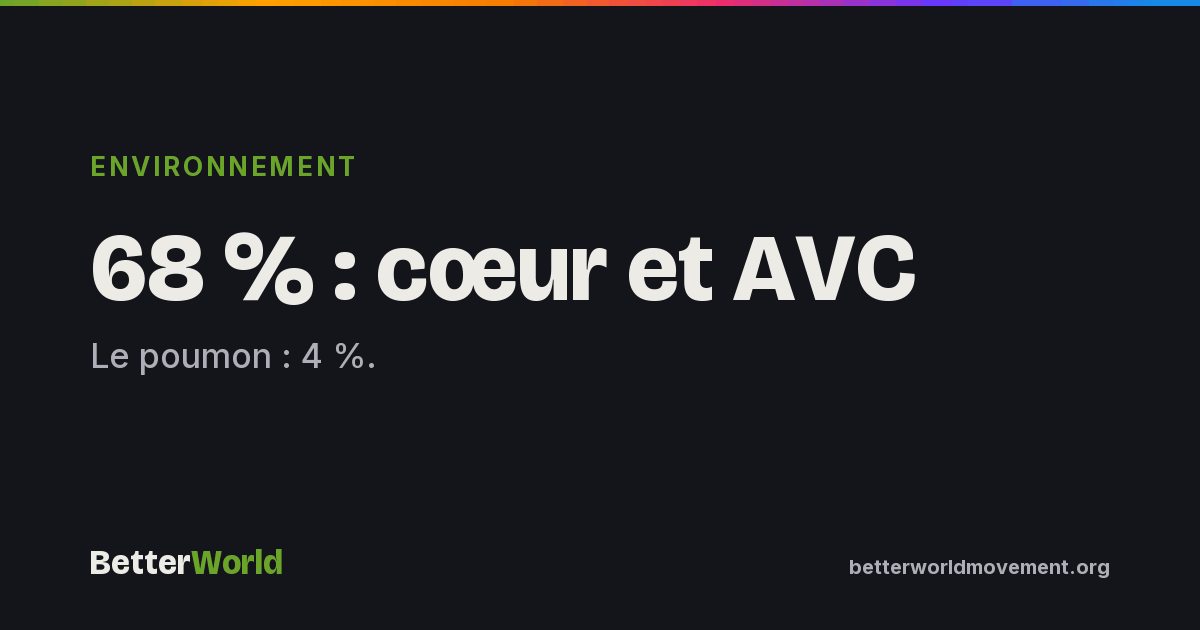 68% of deaths from polluted air: heart disease and strokeWe file air pollution under lungs. WHO puts lung cancer at 4%, and cardiovascular disease at 68%.7 min read
 A quarter of humanity cooks on an open fire2.1 billion people. The smoke can reach 100 times the acceptable level, and it is women and children who sit closest to the fire.7 min read
 WHO lowered its thresholds. The air had not changed.In 2021, WHO lowered almost all its air quality guideline levels. Not because the air had got worse.8 min read
Myth and reality
"At least indoors the air is clean."
A closed home holds on to what is released inside it, cooking, smoke, cleaning products, dust, and lets in part of what comes from outside. Since we spend so much time there, indoor air weighs heavily in what we actually breathe.